


The World Intangible Investment Report 2026, published by WIPO and Luiss Business School on 8 July 2026, ranks India as the fastest-growing major economy in intangible investment, with spending on software, R&D, intellectual property and organisational capabilities reaching $78.2 billion in 2023 — a 7.9% year-on-year growth rate that outpaces Japan (4.8%), the US (4.4%) and all 15 largest economies covered in the study. Software and databases account for 45% of India’s intangible investment, the highest share globally. For foreign companies, investors and economic development agencies, these findings confirm a structural shift in India’s economy from a low-cost production base to an innovation-driven knowledge economy. T&A Consulting helps organisations understand and position for India’s transition to an innovation-led growth model.
Introduction: The Structural Shift
For decades, India’s economic narrative was centred on tangible investment — factories, roads, ports, railways and physical infrastructure. This investment continues at scale: India’s gross capital formation stood at 33% of GDP in 2023, and the government’s capital expenditure in Budget 2026 grew by 7.7%. But alongside this physical build-out, a parallel transformation is underway. India is investing in intangible assets — software, data, research, brands, design and organisational know-how — at a rate that outpaces every other major economy.
The WIPO report provides the data to substantiate what qualitative observers have noted for several years: India is no longer just an outsourcing hub for low-cost labour. It is building proprietary technology, original intellectual property and knowledge-driven capabilities that generate higher-value output and more productive employment. This transition has profound implications for how foreign companies, investors and governments should think about India as a business destination.
What the WIPO Data Shows
- Fastest growth among major economies. India recorded 7.9% year-on-year growth in intangible investment between 2022 and 2023, the highest among the world’s 15 largest economies. Japan was second at 4.8%, followed by the Philippines (4.6%) and the US (4.4%).
- $78.2 billion in absolute terms. India’s intangible investment exceeds that of several European economies including Denmark, Czech Republic and Finland, despite India’s significantly lower GDP per capita.
- Software dominance. Software and databases account for 45% of India’s total intangible investment — the highest share globally. This reflects the IT services industry’s continued evolution from labour arbitrage toward product engineering, SaaS development and AI capabilities.
- Broad-based growth. Organisational capital comprised 21.8%, R&D 12.7%, design 11% and brands 9.3% of India’s intangible investment. Software and databases expanded at a CAGR of 8.2% between 2013 and 2023. Brand investment grew at 7.2% CAGR over the same period.
- Intangible investment at 10% of GDP. India’s formal-sector intangible investment reached 10% of GDP in 2023, on a steady upward trajectory. While tangible investment (19.3% of GDP) remains higher as infrastructure development continues, the gap is narrowing.
What Is Driving India’s Intangible Investment Growth
- IT services evolution. India’s IT industry, which generates over $250 billion in annual revenue and employs 5.5 million professionals, has shifted from body-shopping and maintenance to product engineering, cloud-native development, AI/ML and platform building. The industry’s investment in proprietary software and technology platforms drives the software/databases category.
- GCC transformation. Over 2,100 GCCs in India now function as innovation centres rather than cost centres. Their investment in R&D, product design, AI capabilities and organisational know-how directly contributes to India’s intangible investment growth.
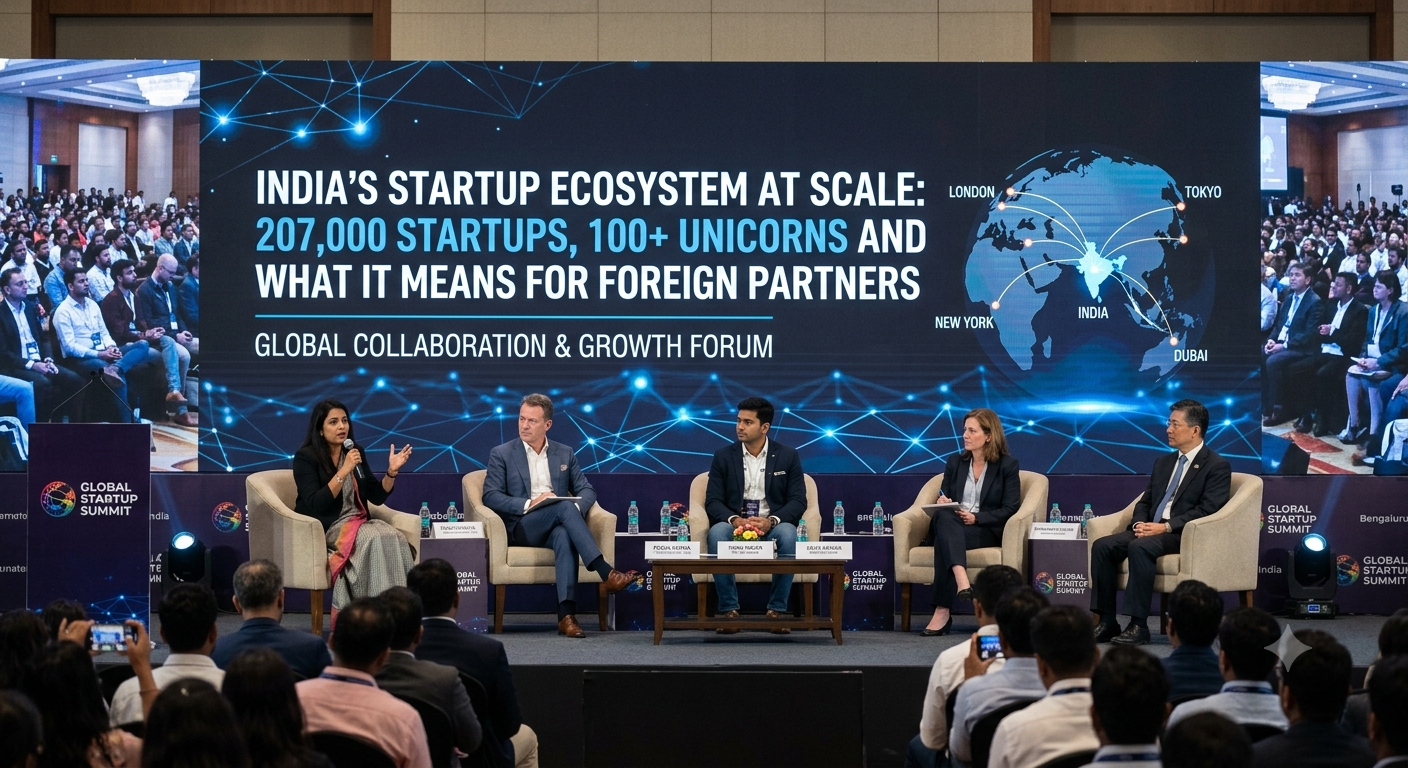
- Startup ecosystem. With 207,000+ recognised startups and 100+ unicorns, India’s startup ecosystem is producing significant volumes of software, IP and brand assets. Nearly half of startup activity now comes from Tier-2 and Tier-3 cities.
- Government policy support. The IndiaAI Mission, ISM 2.0, the Design Linked Incentive scheme and the deep-tech startup support programme all encourage intangible asset creation. The 20-year eligibility period for deep-tech startups and the Rs 100 billion venture fund signal long-term commitment.
- Digital public infrastructure. India Stack (Aadhaar, UPI, ONDC, GSTN) creates a shared digital foundation that reduces the cost of building digital products and services, lowering the barrier to intangible asset creation across the economy.
Implications for Foreign Companies and Investors
- India as an R&D destination. The WIPO data validates India’s positioning as a destination for R&D investment, not just manufacturing or services delivery. Companies seeking to build proprietary technology, AI capabilities or product engineering teams should consider India alongside traditional R&D hubs in the US, Israel and Europe.
- IP creation and protection. As India’s intangible investment grows, IP creation and protection become increasingly important. India’s IP regime, strengthened through the DPDP Act, the India-EU FTA and the India-EFTA TEPA provisions, is evolving to support knowledge-economy requirements.
- Talent strategy. India added 5.2 million new developers in a single year, making it the largest source of new developers globally. Nearly 80% of new Indian developers start using AI coding tools within their first week. This talent profile supports intangible-intensive business models.
- Valuation implications. Companies building or acquiring India operations should factor in the growing intangible asset base — software, IP, brands, organisational capabilities — when valuing India entities. Traditional approaches that focus primarily on physical assets may undervalue knowledge-intensive operations.
- ESG and sustainability. Intangible-intensive economies tend to be less carbon-intensive per unit of GDP. India’s shift toward knowledge assets may support long-term ESG positioning for companies operating in the country.
The Global Context: Why This Matters Beyond India
The WIPO report reveals a broader global trend: intangible investment has surpassed $10 trillion globally for the first time, growing 5.5% annually between 2020 and 2025 compared to 3.2% for tangible investment. Intangibles now account for 12.8% of GDP across covered economies, exceeding tangible investment’s share of 11.8%. India’s rapid growth in this category positions it to capture a growing share of global value creation as the world economy becomes increasingly knowledge-driven.
For economic development agencies, the WIPO findings provide a new dimension to India’s investment attraction narrative. India is no longer competing solely on cost, market size or trade agreement access. It is competing on innovation capability, and the data shows it is winning that competition faster than any other major economy.
How T&A Consulting Supports Innovation-Led Strategy
T&A Consulting helps foreign organisations navigate India’s innovation economy:
- R&D and GCC strategy. We advise on establishing and scaling R&D centres, GCCs and innovation labs in India, covering location selection, talent strategy and IP governance.
- IP advisory. We guide companies on India’s IP protection framework, including patent, trademark and design registration, trade secret management and enforcement.
- Investment attraction. We help IPAs and EDAs incorporate India’s innovation economy positioning into their investment promotion strategies.
- Partnership facilitation. We connect foreign companies with Indian startups, research institutions and technology providers for innovation partnerships.
- Market intelligence. We provide data-driven analysis of India’s innovation ecosystem, covering sector-specific R&D activity, talent availability, IP landscape and competitive positioning.
The WIPO report confirms what the data has been signalling: India is undergoing a structural economic transition from tangible to intangible value creation, faster than any other major economy. This is not a future prediction — it is a present reality backed by $78.2 billion in measured investment. The companies and organisations that recognise and engage with this transition will find an India that is fundamentally different from the cost-arbitrage narrative of the past decade.
Contact us at: pnijhawan@taglobalgroup.com to explore innovation economy opportunities in India.
Sources & references:
WIPO,
Business Standard,
ANI News,
IBEF,
NextIAS