


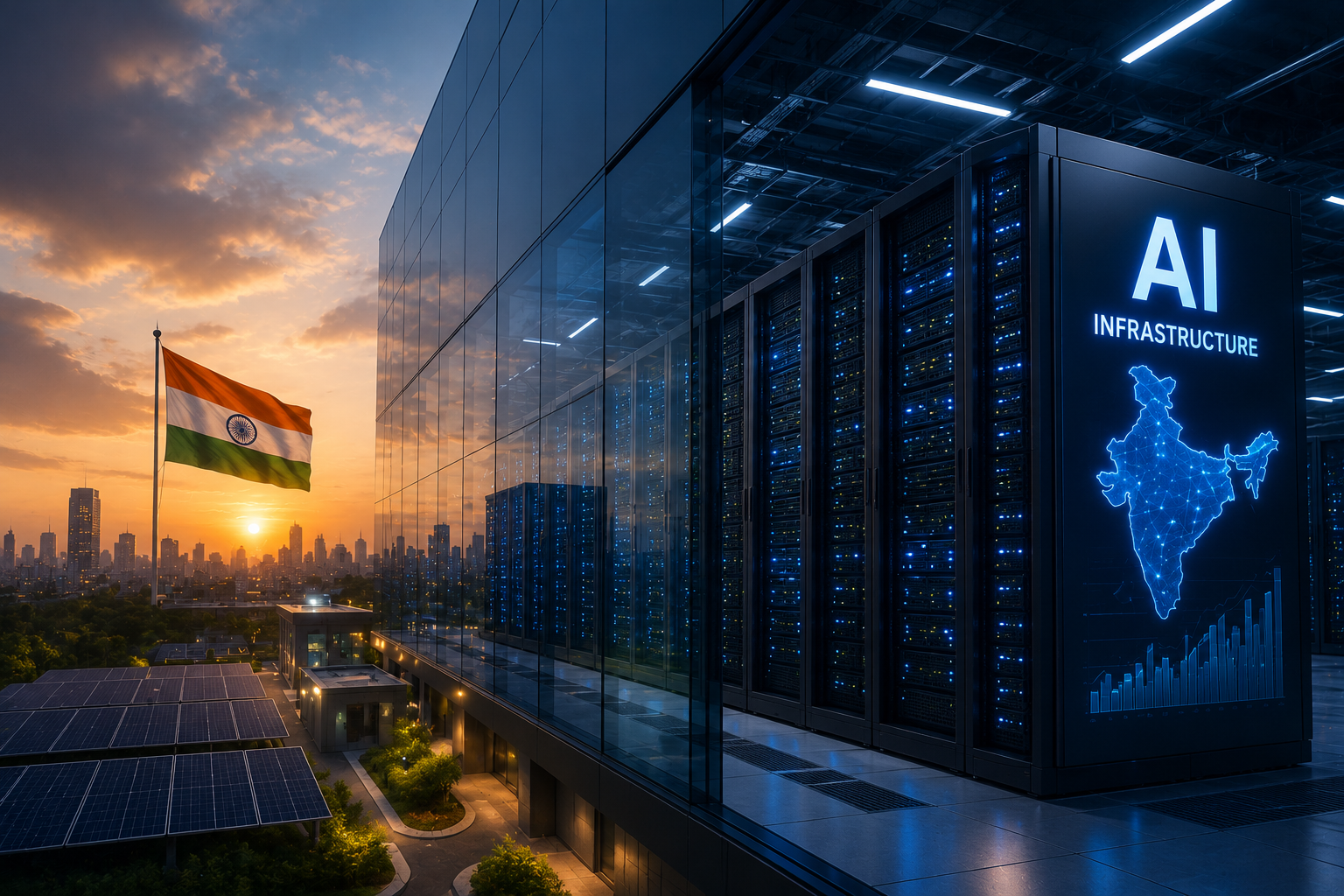
India is positioning itself as a global hub for artificial intelligence infrastructure, with over $250 billion in commitments announced at the India AI Impact Summit 2026. Microsoft has committed $17.5 billion, Google $15 billion, Reliance-Jio $110 billion over seven years and Adani Group $100 billion for data centre and AI compute expansion. The government has announced tax holidays until 2047 for foreign cloud companies using Indian data centres, a Rs 100 billion venture programme for deep-tech startups and plans to add 20,000 GPUs through the IndiaAI Compute initiative. T&A Consulting helps foreign technology companies, investors and economic development agencies understand India’s emerging AI infrastructure landscape and identify investment and partnership opportunities.
Introduction: AI Infrastructure as Industrial Policy
The India AI Impact Summit 2026, held in New Delhi in February, was the fourth in a series of global AI gatherings and the first hosted by a Global South nation. The summit’s dominant theme was clear: AI infrastructure is no longer discretionary technology spending. It is industrial policy. The scale and coordination of capital commitments signal that compute capacity is being embedded into national economic strategy alongside manufacturing, energy and transportation.
India’s pitch is built on a compelling combination: the world’s largest pool of STEM talent (2.5 million graduates annually), competitive energy and labour costs, a 5.2 million new developer surge in a single year (making India the largest source of new developers globally), and a government willing to deploy significant fiscal incentives to attract AI investment. The Indian AI industry is expected to exceed $7 billion by the end of 2026 and cross $35 billion by 2032, with data centre capacity projected to surge from approximately 1.5 GW in 2025 to over 6.5 GW by 2030.
The Investment Landscape: Who Is Committing What
- Reliance Industries and Jio. The largest single commitment: a multi-gigawatt AI data centre and edge compute expansion programme backed by $110 billion over seven years. This includes AI-optimised facilities, national GPU scaling initiatives and integration with Jio’s existing 5G and fibre infrastructure.
- Adani Group. Plans to invest approximately $100 billion to expand its data centre platform from roughly 2 GW to 5 GW, positioning the additional capacity for AI-ready workloads.
- Microsoft. Reiterated its previously announced $17.5 billion commitment to expand cloud and AI infrastructure in India, part of a broader $50 billion Global South investment plan through 2030. More than 40% of Microsoft’s global R&D workforce is already based in India.
- Google. Confirmed $15 billion for an AI hub in India, focused on cloud regions, AI data infrastructure and multilingual model development.
- Amazon. Reaffirmed its multibillion-dollar India expansion roadmap for AWS cloud regions and AI computing infrastructure.
- Blackstone. Acquired a major stake in AI infrastructure startup Neysa, and its REIT raised approximately Rs 16,782 crore ($1.75 billion) to acquire data centres, targeting the growing demand for digital infrastructure and high-speed data processing.
Government Policy Architecture
India’s AI infrastructure push is supported by a coordinated policy framework:
- IndiaAI Mission 2.0. The government’s flagship AI programme, with Union Budget 2026-27 allocating Rs 1,000 crore to support AI startups, cloud infrastructure and domestic technology providers. The mission aims to expand shared GPU access beyond 100,000 units through the IndiaAI Compute initiative, including an immediate addition of 20,000 GPUs.
- Tax holiday until 2047. Budget 2026 announced a tax holiday until 2047 for foreign cloud companies using Indian data centres, positioning India as a globally competitive hosting destination for AI workloads. This single measure could redirect significant AI infrastructure investment that would otherwise go to Singapore, the Middle East or Southeast Asia.
- ISM 2.0 (India Semiconductor Mission). The government has sharpened its focus on high-value segments of the chip value chain, including equipment, materials and full-stack Indian IP. The Electronic Component Scheme outlay has been increased to Rs 40,000 crore.
- Deep-tech startup support. A Rs 100 billion government-backed venture programme targets high-risk areas including AI and advanced manufacturing. The eligibility period for deep-tech companies to qualify as startups has been extended to 20 years, with the revenue threshold raised to Rs 3 billion.
- MANAV governance framework. India’s responsible AI governance framework, along with the New Delhi Frontier AI Commitments, positions India as a jurisdiction that combines investment incentives with regulatory guardrails.
Data Centre Capacity: The Physical Layer
AI workloads are compute-intensive and require massive data centre infrastructure. India’s data centre capacity is currently approximately 1.5 GW, concentrated in Mumbai, Chennai, Hyderabad, Pune and Delhi-NCR. By 2030, this is projected to surge to over 6.5 GW, a more than fourfold increase driven by demand from AI training and inference, cloud migration, digital services and regulatory requirements for data localisation.
Global data centre operators (Equinix, Digital Realty, NTT, ST Telemedia) and Indian players (Nxtra by Airtel, Yotta, CtrlS) are all expanding capacity. The convergence of AI demand, favourable tax policy and India’s growing domestic digital economy makes data centre investment one of the most attractive infrastructure plays in the country.
For foreign investors and operators, the key considerations are: power availability and cost (data centres are energy-intensive), land availability in key metros, cooling infrastructure in India’s tropical climate, connectivity to submarine cable landing stations and regulatory compliance with India’s data protection and localisation requirements.
Opportunities for Foreign Companies
- AI infrastructure providers. Companies specialising in GPU clusters, AI-optimised servers, cooling systems, power management and data centre design will find a rapidly expanding market.
- Cloud and SaaS companies. The tax holiday until 2047 for foreign cloud companies using Indian data centres creates a unique opportunity to establish India operations with a long-term fiscal advantage.
- Semiconductor and chip design. Over 50 GCCs already have dedicated semiconductor design units in India. Companies in the fabless semiconductor value chain can leverage India’s talent and incentive framework.
- AI application companies. Healthcare, agriculture, financial services, education and urban administration are all identified as priority sectors for AI application. Foreign AI companies with proven solutions in these verticals have a natural market.
- System integrators. The deployment of AI at enterprise scale requires system integration expertise. Companies that control enterprise transformation roadmaps hold significant operational leverage in India’s AI adoption cycle.
How T&A Consulting Supports AI Infrastructure Strategy
T&A Consulting helps foreign technology companies and investors navigate India’s AI and data infrastructure landscape:
- Market assessment. We evaluate the India opportunity for specific AI infrastructure segments, including market sizing, competitive analysis and demand forecasting.
- Investment facilitation. We support data centre operators, cloud companies and AI infrastructure providers in identifying sites, securing incentives and setting up operations in India.
- Policy and incentive navigation. We guide companies through the available incentive frameworks, including the data centre tax holiday, ISM 2.0, PLI schemes and state-level policies.
- Partnership identification. We facilitate partnerships between foreign AI companies and Indian enterprises, GCCs and research institutions.
- Regulatory compliance. We advise on data protection, localisation requirements and IRDAI/SEBI/RBI compliance for AI applications in regulated sectors.
India’s AI infrastructure boom is not speculative. It is backed by over $250 billion in announced commitments, a coordinated policy framework and the world’s largest developer talent pool. The companies that establish a presence in India’s AI ecosystem now will benefit from a structural advantage as AI becomes the defining technology of the next decade.
Contact us at: pnijhawan@taglobalgroup.com to explore AI infrastructure opportunities in India.
Sources & references:
TechCrunch,
ERP Today,
Teji Mandi,
PIB,
Tracxn