


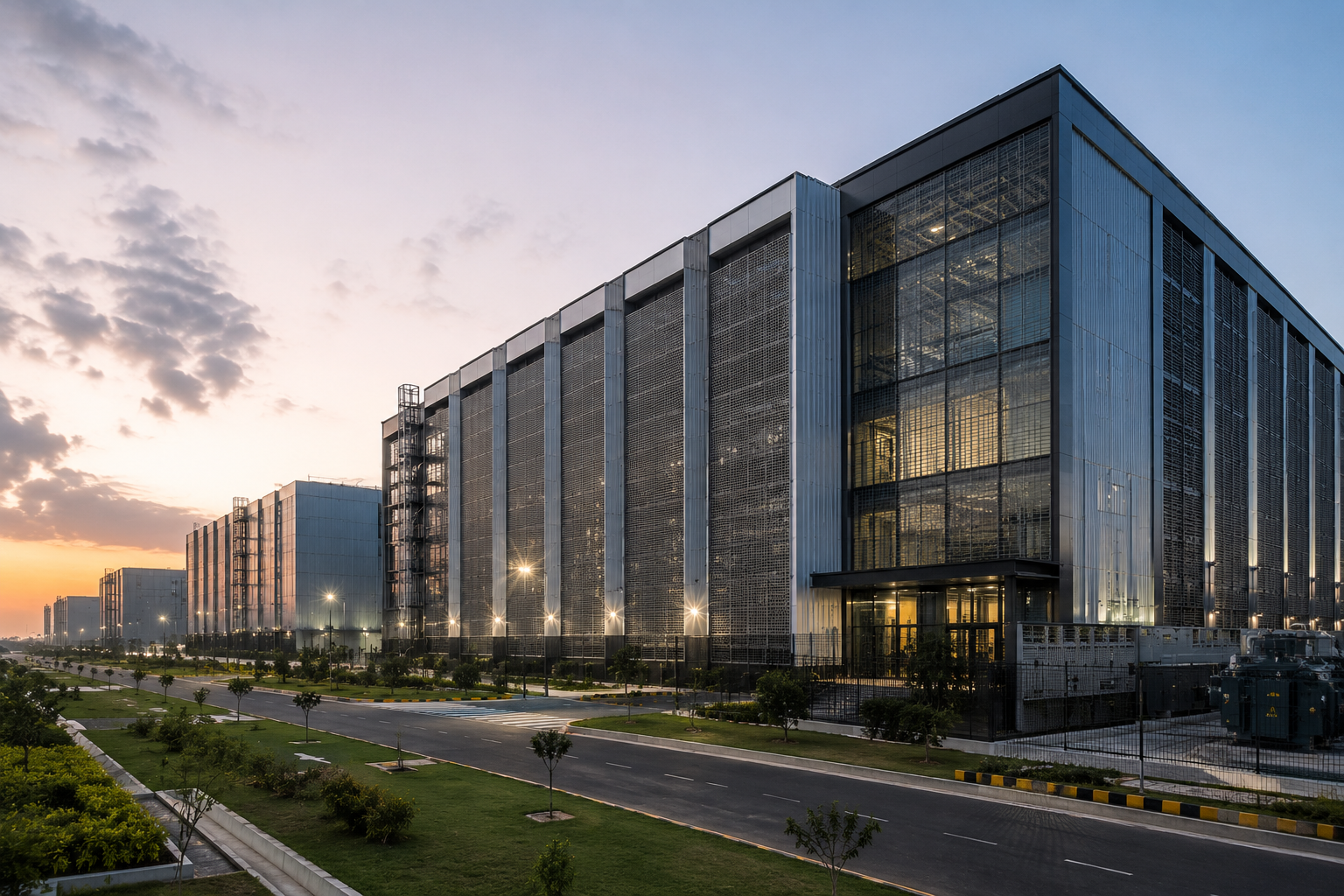
India’s data centre capacity is set to surge from approximately 1.5 GW in 2025 to over 6.5 GW by 2030, a more than fourfold increase driven by AI workloads, cloud migration, digital services expansion and data localisation requirements. Blackstone’s REIT raised $1.75 billion specifically for data centre acquisitions. Reliance and Adani have committed over $200 billion combined toward data centre and digital infrastructure. The government’s tax holiday until 2047 for foreign cloud companies using Indian data centres is the most aggressive fiscal incentive any country has offered for this sector. T&A Consulting helps foreign data centre operators, cloud companies and investors evaluate and enter the Indian data centre market.
Introduction: Why India, Why Now
The convergence of five structural forces is driving India’s emergence as a global data centre hub. First, India’s digital economy contributed 11.74% of GDP in FY 2022-23 and is projected to reach 20% of GVA by FY 2029-30, generating massive domestic demand for data storage and processing. Second, the Digital Personal Data Protection Act, 2023, and sectoral regulations from RBI, SEBI and IRDAI increasingly require that certain categories of data be stored and processed within India, creating a regulatory driver for onshore data centre capacity. Third, the explosive growth of AI workloads (training and inference) demands purpose-built GPU clusters and high-density computing facilities that the existing installed base cannot support. Fourth, India’s expanding network of submarine cables (now over 17 cable landing stations) provides the international connectivity required for a globally competitive hosting market. And fifth, the government has introduced the most aggressive fiscal incentives for data centres of any major economy.
Market Size and Growth Trajectory
India’s data centre market is currently valued at approximately $5.7 billion and is projected to grow to $12-15 billion by 2030. Capacity is concentrated in five primary markets: Mumbai (approximately 45% of installed capacity), Chennai (20%), Hyderabad (15%), Pune (10%) and Delhi-NCR (10%). Mumbai’s dominance reflects its position as India’s financial capital and the location of the country’s largest submarine cable landing stations.
New capacity is being added at an unprecedented pace. In 2025, GCCs accounted for 38% of office leasing across India’s top seven cities, and data centre operators are among the fastest-growing commercial real estate tenants. Blackstone’s REIT raised approximately Rs 16,782 crore ($1.75 billion) specifically to acquire data centres, signalling institutional investor confidence in the asset class. India’s government plans to invest over Rs 1,68,000 crore ($20 billion) in offshore energy mapping, partly to support the massive power requirements of next-generation data centres.
Policy and Incentive Framework
- Tax holiday until 2047 for foreign cloud companies. Budget 2026 announced a tax holiday for foreign cloud companies that use Indian data centres for export-oriented services. This is the most generous fiscal incentive globally for this sector, providing a multi-decade cost advantage over competing locations in Singapore, the Middle East and Southeast Asia.
- Infrastructure status. Data centres have been granted “infrastructure” status by the government, enabling access to long-term financing at lower interest rates, simplified land acquisition processes and other benefits typically reserved for physical infrastructure projects.
- State-level incentives. Maharashtra, Tamil Nadu, Telangana, Karnataka and Gujarat have all introduced data centre-specific policies offering capital subsidies, power tariff concessions, stamp duty waivers and expedited approvals. Maharashtra’s policy offers capital subsidies of up to Rs 100 crore for large facilities.
- SEZ and IFSC benefits. Data centres established in SEZs or GIFT City’s IFSC can benefit from additional tax holidays, duty-free imports of equipment and simplified customs procedures.
- Renewable energy alignment. India’s target of 500 GW non-fossil fuel energy capacity by 2030 provides a pathway for data centres to secure green power through renewable energy purchase agreements, addressing ESG concerns and reducing long-term energy costs.
Key Players and Investment Activity
- Indian conglomerates. Reliance-Jio ($110 billion for AI and digital infrastructure), Adani Group ($100 billion for data centre expansion from 2 GW to 5 GW), Airtel’s Nxtra (expanding to 400 MW by 2027) and the Hiranandani Group’s Yotta (operating India’s largest single-site data centre in Mumbai) are the dominant domestic players.
- Global hyperscalers. Microsoft ($17.5 billion), Google ($15 billion) and Amazon (multi-billion-dollar expansion) are all building or expanding cloud regions in India. Their investments anchor demand for third-party colocation and connectivity services.
- International operators. Equinix, Digital Realty, NTT, ST Telemedia Global Data Centres and CapitaLand are all operational or expanding in India. Equinix’s Mumbai facility and NTT’s multi-city presence demonstrate sustained international operator interest.
- Institutional investors. Blackstone’s $1.75 billion REIT acquisition, Brookfield’s investments and sovereign wealth fund interest (Singapore’s GIC, Abu Dhabi’s ADIA) indicate that data centres are emerging as a major institutional-grade asset class in India.
Challenges and Considerations
- Power availability and cost. Data centres are energy-intensive, and India’s power infrastructure is uneven across geographies. While renewable energy is increasingly available, grid reliability and power pricing vary significantly by state. Companies must secure dedicated power arrangements and evaluate the total cost of energy over the facility’s lifecycle.
- Land and real estate. Suitable land parcels in prime metro locations are increasingly scarce and expensive. Secondary cities (Pune, Navi Mumbai, Hosur near Chennai) are emerging as alternatives for large-scale facilities.
- Cooling infrastructure. India’s tropical climate creates higher cooling costs compared to Nordic or temperate locations. Advanced cooling technologies (liquid cooling, adiabatic systems) are essential for AI-grade facilities.
- Connectivity. While submarine cable landing stations are concentrated in Mumbai and Chennai, new cable systems (including India-Europe cable routes and Pacific connectivity) are being planned. Companies evaluating non-metro locations must assess latency and connectivity requirements.
- Regulatory compliance. Data protection, localisation requirements and sectoral regulations (RBI for financial data, SEBI for market data, IRDAI for insurance data) create compliance obligations that operators must address in facility design and operations.
How T&A Consulting Supports Data Centre Market Entry
T&A Consulting provides comprehensive advisory for foreign data centre operators, cloud companies and investors entering the Indian market:
- Market assessment and feasibility studies. We evaluate the India data centre opportunity for specific operator profiles, including demand analysis, competitive landscape, site assessment and financial modelling.
- Site selection and state-level incentive navigation. We identify optimal locations based on power availability, connectivity, land costs and state incentive packages, and manage the incentive application process.
- Entity setup and regulatory compliance. We manage company incorporation, infrastructure licensing, environmental clearances and ongoing compliance for data centre operations.
- Investment facilitation. We support institutional investors evaluating data centre assets in India, providing market intelligence, deal flow identification and due diligence support.
- Partnership identification. We facilitate partnerships between international operators and Indian developers, power providers and enterprise customers.
India’s data centre market is at an inflection point. The convergence of AI-driven demand, the world’s most generous tax incentives, massive domestic digital adoption and institutional capital flows is creating a once-in-a-generation opportunity. The operators and investors that establish a presence now will benefit from structural advantages that compound over the next two decades.
Contact us at: pnijhawan@taglobalgroup.com to explore data centre opportunities in India.
Sources & references:
TechCrunch,
ERP Today,
JLL India,
PIB,
IndiaIPO