


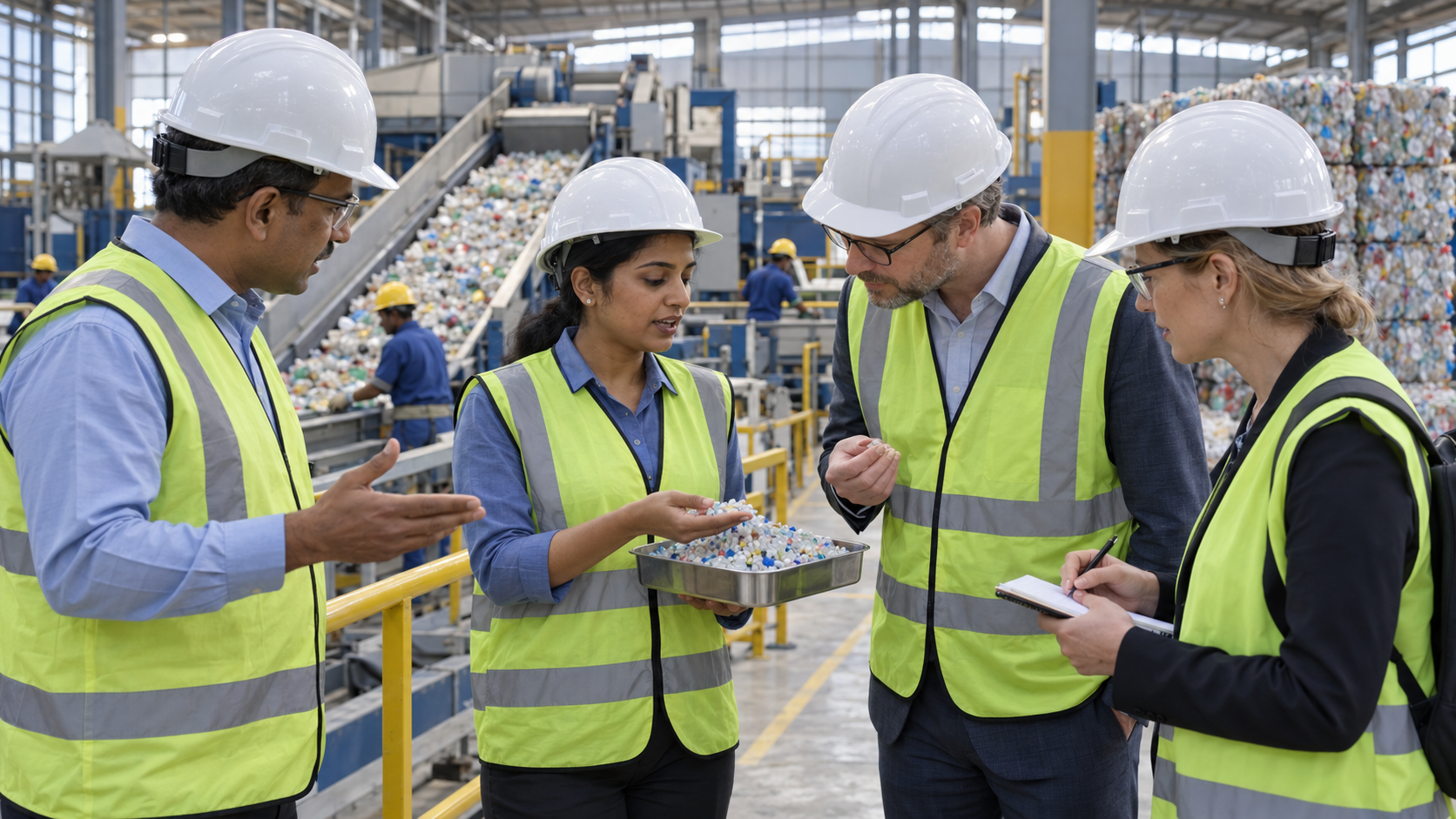
From 15 to 18 September 2026, Gandhinagar hosted the 10th World Circular Economy Forum (WCEF2026), the first edition held in South Asia, bringing more than 2,000 stakeholders from over 65 countries, 135 exhibitors and 80 accelerator sessions to Mahatma Mandir and partner venues worldwide. The forum landed weeks after the Union Cabinet approved the Rs 23,731 crore (approximately $2.6 billion) GOBARdhan scheme for compressed biogas, and as the Ministry of Environment, Forest and Climate Change signalled the expansion of Extended Producer Responsibility (EPR) to new sectors. Gujarat’s government projects that India’s circular economy could exceed $2 trillion in market value and generate around 10 million jobs by 2050. T&A Consulting helps foreign technology providers, investors and economic development agencies identify, structure and enter India’s circular economy opportunities, from EPR-driven recycling to bioenergy and secondary raw materials.
Introduction: Why WCEF2026 Matters Beyond the Conference Hall
The World Circular Economy Forum is organised annually by the Finnish Innovation Fund Sitra. For its tenth edition, Sitra partnered with India’s Central Pollution Control Board, supported by the Ministry of Environment, Forest and Climate Change and the Government of Gujarat. Union Environment Minister Bhupender Yadav and Gujarat Chief Minister Bhupendra Patel opened the forum under the theme “Circular Economy: Transition for People and Prosperity”, with sessions organised around governance, growth and finance tracks covering EPR frameworks, circular public procurement, blended finance and sovereign green bonds.
The decision to bring the forum to India reflects a structural shift. India’s industrial base is expanding rapidly: real GDP grew 7.8% in the first quarter of FY 2026-27, gross fixed capital formation rose 11.9% and capital goods production increased 15.2%. That expansion means rapidly rising demand for metals, plastics, construction materials and energy, much of which India imports. Recovering and re-using materials is therefore not only an environmental agenda but a question of resource security, import substitution and industrial competitiveness.
The forum also released two practical publications, “Driving Sustainability: A Guide to India’s Circular Economy and EPR Initiatives” and “Best Practices for Reuse of Treated Sewage”, and hosted the in-person board meeting of the UN’s 10-Year Framework of Programmes on Sustainable Consumption and Production. Finland’s Ambassador to India, Mikko Kivikoski, framed India as pivotal to strengthening the global circular economy framework. For foreign companies and agencies, WCEF2026 marks the point at which India’s circular economy moved from policy ambition to an investable market.
The Policy Architecture Turning Waste into Markets
India’s circular economy is being built through regulation that assigns cost and responsibility to producers, combined with fiscal support for the infrastructure needed to process recovered materials.
- Extended Producer Responsibility regimes. India has notified EPR obligations under the Plastic Waste Management Rules, the E-Waste Management Rules and the Construction and Demolition Waste Management Rules, alongside a Metals Recycling Policy. EPR converts recycling from a cost centre into a compliance-driven market, because producers must fund the collection and processing of their products at end of life.
- EPR expansion to new sectors. In September 2026, Ved Prakash Mishra, Joint Secretary at the Ministry of Environment, Forest and Climate Change, confirmed at a FICCI event that the government is preparing to extend EPR to additional sectors, building on Circular Economy Action Plans already finalised for 10 waste categories.
- GOBARdhan. Approved by the Union Cabinet in August 2026, the Galvanizing Organic Bio-Agro Resources Dhan scheme has an outlay of Rs 23,731 crore over FY 2026-27 to FY 2035-36. Implemented by the Ministry of Petroleum and Natural Gas, it targets an approximately tenfold increase in compressed biogas production from agricultural residue, cattle dung and organic waste.
- State-level policies. States are adding their own frameworks. Andhra Pradesh’s 2025-2030 circular economy policy sets zero-waste goals and supports new MSMEs that convert waste into products, with an initial allocation of Rs 904 crore (approximately $100 million).
- Carbon market linkages. In January 2026, secondary aluminium produced from recycled scrap was brought under the compliance mechanism of the Carbon Credit Trading Scheme, signalling that recycled materials will increasingly be valued for their lower emissions intensity as well as their material content.
International cooperation is reinforcing the domestic framework. In his inaugural address, Bhupender Yadav pointed to the New Delhi Declaration adopted at the BRICS Summit held in the capital on 12-13 September 2026 and the India-EU joint framework as platforms that carry circular economy priorities into India’s trade and diplomatic relationships. The forum’s growth track focused squarely on capital: blended finance, sovereign green bonds, risk-guarantee mechanisms and venture capital for scaling circular solutions. For foreign investors, this signals that the policy conversation in India has moved past whether circularity matters to how projects will be financed, de-risked and scaled, which is precisely where international experience and capital are most needed.
Five Investable Segments for Foreign Players
The combination of producer obligations, fiscal incentives and export pressure from carbon border measures creates distinct opportunities where foreign technology, capital and operating experience carry a premium.
- E-waste and battery recycling. EPR obligations on electronics producers, combined with India’s push to secure critical minerals, make advanced recovery of copper, cobalt, lithium and rare earths a strategic priority. Foreign firms with hydrometallurgical and black-mass processing technology can partner with authorised Indian recyclers that hold collection networks but lack high-yield recovery capability.
- Compressed biogas and bioenergy. GOBARdhan’s Rs 23,731 crore outlay and its target of a roughly tenfold increase in compressed biogas output create demand for anaerobic digestion technology, feedstock aggregation systems and plant operation expertise, areas where Nordic and European providers have long track records.
- Plastics recycling and packaging. The Alliance to End Plastic Waste has named India one of its five priority countries. EPR targets for recycled content create demand for food-grade recycling, chemical recycling and sorting technology that can integrate with India’s large informal collection sector.
- Secondary metals. Under the EU’s Carbon Border Adjustment Mechanism, Indian steel and aluminium exporters face pressure to shift from blast furnace routes towards scrap-based electric arc furnaces. Scrap processing, sorting and quality assurance, and low-carbon secondary aluminium, are investable segments where demand is driven by export competitiveness as much as by domestic policy.
- Digital traceability and EPR compliance. EPR credit trading, recycled-content verification and carbon accounting all depend on reliable data. Platforms for material tracking, digital product passports and monitoring, reporting and verification are a lower-capital entry point for foreign technology companies.
Most of these activities fall under India’s automatic route for foreign direct investment, meaning no prior government approval is required. The constraints are practical rather than legal: securing consistent feedstock, integrating informal collection networks, navigating state pollution control board consents and finding partners with land and licences already in place.
Implications for Investors, Technology Providers and EDAs
- Foreign technology providers. Lead with partnership rather than greenfield entry. Joint ventures or technology licensing with authorised Indian recyclers and CBG developers reduce feedstock and licensing risk, while allowing foreign firms to capture value through equipment, process know-how and operations contracts.
- European and Nordic economic development agencies. WCEF2026 created a platform for circular economy clusters in Finland, the Netherlands and across Europe to showcase their capabilities to Indian buyers and policymakers. Agencies should convert that visibility into structured market entry programmes for their companies, aligned with India’s EPR and bioenergy schemes.
- Indian state IPAs. Gujarat, Andhra Pradesh and other states can attract circular economy investment by offering dedicated recycling parks with pre-cleared environmental consents, assured municipal and industrial feedstock, and fast-track approvals, packaged as investor-ready propositions.
- Foreign brands operating in India. Multinational consumer goods, electronics and packaging companies are themselves obligated producers under EPR. Investing in recycling capacity, or partnering with recyclers through long-term offtake agreements, can turn a compliance cost into a supply chain advantage.
- Investors and development finance institutions. The forum’s emphasis on blended finance, risk guarantees and sovereign green bonds signals growing support for de-risking circular projects. Infrastructure funds should assess platforms that aggregate multiple recycling or bioenergy assets to achieve scale.
How T&A Consulting Supports Circular Economy Investment in India
T&A Consulting works with economic development agencies, technology providers and investors across Europe, Asia and Africa on India market entry and investment promotion:
- Circular economy market assessments. We map EPR obligations, feedstock availability, competitor landscapes and state-level incentives across segments, from e-waste and batteries to plastics, metals and bioenergy.
- Partner identification and due diligence. We identify and screen authorised recyclers, CBG developers, municipal bodies and industrial partners suited to joint ventures, licensing or offtake arrangements.
- Market entry and regulatory navigation. We advise on entity structure, FDI and FEMA compliance, pollution control consents and EPR registration for foreign companies establishing operations in India.
- Programmes for European EDAs. We design and deliver India market entry programmes, trade missions and buyer engagement for European and Nordic cleantech clusters seeking to build on the momentum of WCEF2026.
- Investment promotion for Indian states. We help state IPAs structure recycling parks and circular economy propositions and present them to international investors and technology providers.
WCEF2026 marked the moment India’s circular economy moved from the policy page to the investment pipeline. With producers now legally responsible for their waste and capital flowing into bioenergy and recycling, the foreign firms that bring proven technology and patient partnership will help shape a market projected to exceed $2 trillion by 2050.
Contact us at: pnijhawan@taglobalgroup.com to explore circular economy partnerships and investment opportunities in India.
Sources & references:
All India Radio: India committed to promoting circular economy, says Environment Minister at WCEF,
IANS: WCEF 2026 inaugurated in Gandhinagar,
The CSR Journal: Gujarat CM inaugurates World Circular Economy Forum 2026,
Press Information Bureau: India’s GDP Performance, Q1 2026-27,
Outlook Business: Circular economy can unlock $2T market,
Waste & Recycling Middle East: Scaling infrastructure and investment in India’s circular plastics economy