


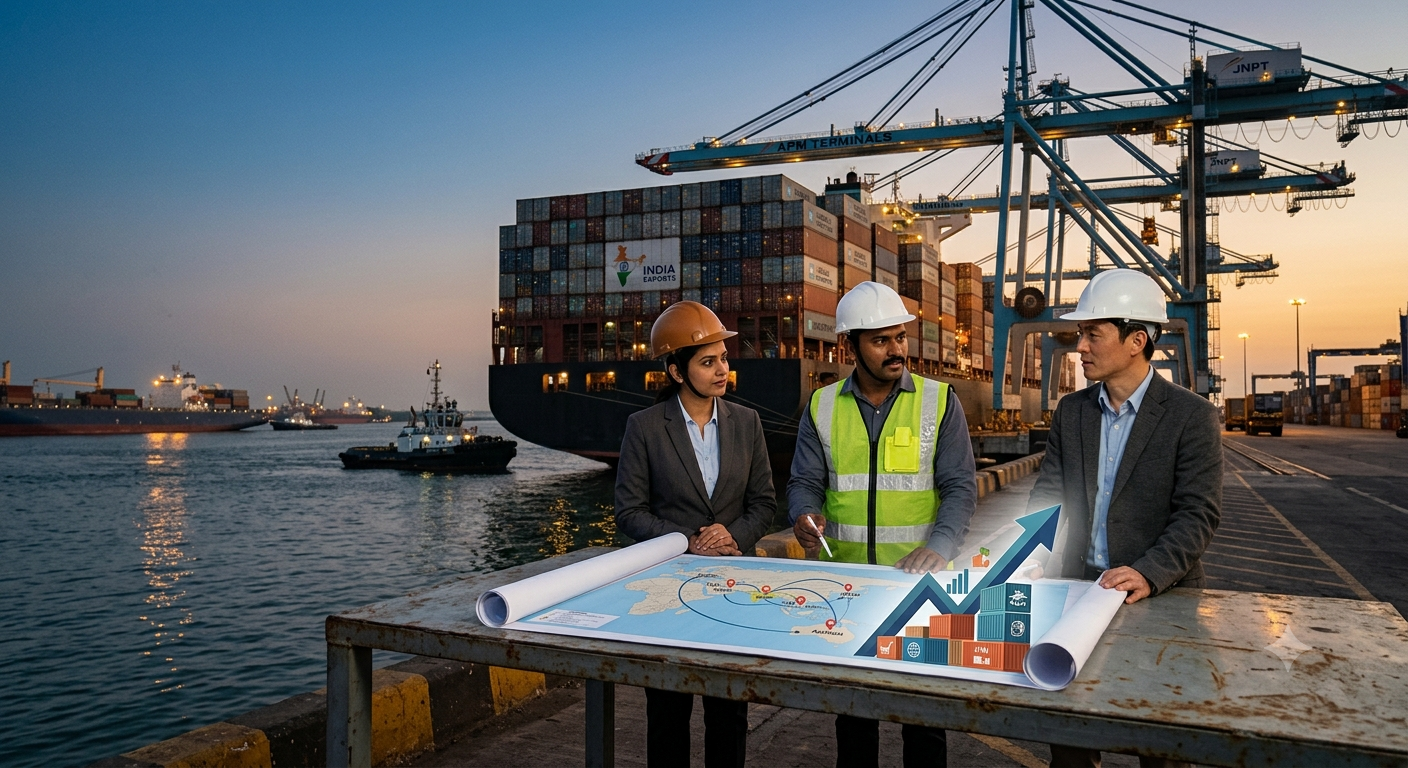
India’s merchandise exports rose approximately 15% in April-June 2026, reaching $45.2 billion in May alone — a six-month high — despite global economic uncertainties and US tariff headwinds. During April-May, exports increased 16.09% to $88.91 billion. April exports hit $43.6 billion, the highest monthly level in over four years. Non-petroleum exports rose 11%, demonstrating that the growth is broad-based rather than commodity-driven. Commerce Minister Piyush Goyal attributes the resilience to India’s expanding trade agreement network and diversified export markets. For trade promotion organisations, exporters and foreign companies sourcing from India, these numbers mark a structural shift in India’s export competitiveness. T&A Consulting helps businesses and governments leverage India’s trade corridors for export growth and supply chain optimisation.
Introduction: Exports Growing Despite Tariff Headwinds
India’s Q1 FY27 (April-June 2026) export performance is remarkable in context. It comes despite the US imposing an 18% effective tariff on Indian goods (reduced from 50% in February 2026 but still significantly above the pre-2025 baseline), the West Asia conflict disrupting shipping routes through the Red Sea, global demand softening in Europe and continued supply chain realignments. That exports grew 15% in this environment signals that India’s export engine is becoming more resilient, diversified and competitive.
The government anticipates further gains once the first phase of the comprehensive bilateral trade agreement with the US concludes, removing temporary 10% tariffs under Section 301 investigations from July 24. The India-EU FTA (expected to enter force in early 2027) and the India-EFTA TEPA (in force since October 2025) are expected to accelerate export growth further as tariff reductions take effect.
What Is Driving the Export Surge
- Trade agreement dividends. The India-UK CETA (99% duty-free access), India-EFTA TEPA (tariff concessions plus $100 billion FDI commitment), India-Australia ECTA (85%+ tariff elimination) and the US interim deal (zero tariffs on gems, pharma, smartphones, handicrafts) are collectively opening new export corridors. The India-EU FTA, once in force, will add the world’s largest free trade zone to India’s preferential market access network.
- PLI scheme output. Manufacturing output under PLI schemes is translating into export volumes, particularly in electronics (mobile phone exports exceeding $15 billion), pharmaceuticals, textiles and auto components. The PLI model’s production incentives are directly linked to incremental sales, creating an export-oriented manufacturing base.
- China plus one supply chain shifts. Global companies diversifying supply chains away from China continue to source increasing volumes from India. This is particularly evident in electronics, engineering goods, chemicals and textiles where Indian manufacturers are capturing orders previously held by Chinese suppliers.
- Petroleum and non-petroleum balance. While petroleum product exports benefited from elevated global oil prices, non-petroleum exports grew 11% — demonstrating that India’s export growth is driven by manufacturing competitiveness, not just commodity price cycles.
- Digital infrastructure enabling smaller exporters. India’s DPI stack (GSTN for tax compliance, UPI for payments, ONDC for discovery) is reducing the friction for MSMEs to participate in export markets. The TReDS platform for receivables discounting is improving MSME cash flows, enabling them to fulfil larger export orders.
Sector-Level Export Performance
- Electronics and smartphones. India’s fastest-growing export category. Mobile phone exports alone exceeded $15 billion in FY 2025-26, driven by Apple’s manufacturing expansion through Foxconn, Pegatron and Tata Electronics. The zero-tariff treatment for smartphones under the US interim deal further strengthens this trajectory.
- Pharmaceuticals. India supplies over 20% of the world’s generic medicines. Zero reciprocal tariffs under the US interim deal and tariff elimination under the India-EU FTA protect and expand this position. India’s pharma exports are valued at approximately $28 billion annually.
- Engineering goods. India’s largest export category to the US by value, covering auto components, industrial machinery, electrical equipment and fabricated metals. The tariff reduction from 50% to 18% (and potentially 10%) has restored competitiveness.
- Textiles and apparel. India’s $40+ billion textile industry benefits from duty-free access to the UK under CETA, tariff reductions under the EU FTA and zero-tariff treatment for MSME-driven handicrafts under the US deal.
- Gems and jewellery. India processes over 90% of the world’s diamonds and is the largest exporter of cut and polished stones to the US. Zero reciprocal tariffs under the US deal and tariff elimination under the EU FTA support continued growth.
- Chemicals. Full and immediate tariff elimination on Indian chemicals under the India-UK CETA positions India competitively in the UK’s $28 billion chemicals market, with industry estimates suggesting a 30-40% increase in Indian chemical exports to the UK.
Implications for Trade Promotion Organisations
- Update export promotion priorities. The data shows that India’s export growth is diversifying across both products and markets. TPOs should align their promotion efforts with the sectors and markets where trade agreements deliver the greatest tariff advantage.
- Support MSME exporters. The World Bank’s $1.5 billion DPF operation specifically supports MSME financing and market access. TPOs should design programmes that help MSMEs navigate export documentation, quality standards and trade agreement utilisation.
- Leverage the ECTA/CECA pipeline. The India-Australia CECA, once concluded, will add another preferential market. TPOs should begin preparing exporters for Australian market access opportunities, particularly in processed food, textiles and engineering goods.
- Monitor US BTA developments. The removal of Section 301 tariffs from July 24 and the ongoing comprehensive BTA negotiations will further shape India’s export trajectory to the US.
Implications for Foreign Companies Sourcing from India
- Competitive pricing. India’s combination of PLI-incentivised manufacturing, trade agreement tariff benefits and competitive labour costs makes Indian-sourced goods increasingly price-competitive against Chinese and ASEAN alternatives.
- Diversification advantage. Companies sourcing from India can access preferential tariffs in the EU, UK, EFTA, ASEAN, Japan, South Korea, UAE, Australia and (with caveats) the US — a multi-market sourcing platform.
- Quality improvements. PLI scheme requirements for domestic value addition and quality standards are driving up manufacturing quality. India’s growing base of NABH, JCI and ISO-certified facilities reflects this trend.
- Supply chain resilience. India’s geographic distance from both the Taiwan Strait and Red Sea shipping chokepoints provides a diversification benefit for companies seeking supply chain resilience.
How T&A Consulting Supports Export and Sourcing Strategy
T&A Consulting provides advisory for businesses and organisations operating within India’s export ecosystem:
- Export strategy development. We design export strategies for Indian companies targeting specific markets, incorporating trade agreement provisions, tariff optimisation and market access requirements.
- Sourcing advisory. We help foreign companies identify and evaluate Indian suppliers, manage quality requirements and optimise sourcing costs across trade agreement corridors.
- Trade agreement utilisation. We help exporters and importers understand and utilise rules of origin, tariff schedules and preferential access provisions across India’s FTA network.
- MSME supplier development. We support foreign companies in developing Indian MSME suppliers, including quality upgrading, compliance support and capacity building.
- Trade promotion campaigns. We design and execute trade promotion campaigns for governments and export promotion bodies targeting specific India export sectors and markets.
India’s Q1 FY27 export performance is not an anomaly. It is the early evidence of a structural shift driven by trade agreement proliferation, PLI-incentivised manufacturing and supply chain diversification. The 15% growth despite US tariff headwinds demonstrates that India’s export engine is becoming resilient enough to deliver sustained growth across market cycles.
Contact us at: pnijhawan@taglobalgroup.com to explore India sourcing and export opportunities.
Sources & references:
Banking Finance,
IBEF,
Business Standard,
Ministry of Commerce,
PIB